Food Prices in Korea: Three Price Tags That Explain Everything
A 1,800 won triangle kimbap, a 6,100 won convenience store lunchbox, and an 11,000 won bowl of gukbap. Three photographed prices that map the whole cost of everyday eating in Korea — plus the government survey numbers that back them up.
Prices checked September 3, 2026 · in Seoul, on screen
Three photographs, three price tags. Between them they map almost everything you need to know about the cost of eating in Korea:
- 1,800 won — a Spam kimchi fried rice triangle kimbap, price printed on the label. About $1.31.
- 6,100 won — a GS25 convenience store lunchbox: rice plus a tray of meat, fried chicken pieces, eggs and vegetables, 472 grams of food. About $4.44.
- 11,000 won — a bowl of suyuk-gukbap at a well-known Korean soup chain, read off the menu board. About $8.
That’s the ladder. Convenience store floor, convenience store ceiling, everyday restaurant meal. The rest of this post walks each rung with the photos, then checks them against the Korean government’s own restaurant survey so you know none of this is cherry-picked.
Sources and dates, stated plainly: the three prices above are from labels and a menu I photographed in August–September 2026 — each photo is below. Seoul restaurant averages are from the Korea Consumer Agency’s price portal 참가격 (chamgagyeok), July 2026 survey. Exchange rate used: $1 = 1,374 won, checked September 3, 2026 — rates drift, so treat every dollar figure here as approximate.
The bowl of soup that measures everything
Before the ladder, one piece of local knowledge that’s worth more than any exchange rate table.
When Koreans talk about what an ordinary lunch costs, they often talk about it as the price of a bowl of gukbap (국밥) — soup with rice. Not an official statistic, just how the conversation happens: gukbap is the default working-person’s meal, the thing you eat alone at a counter in fifteen minutes, and its price is shorthand for “what lunch costs now.”
So here’s the current reading on that gauge, off a menu board I photographed at Boseung Hoegwan (보승회관) — a well-known gukbap chain, and the one I actually go to:
Suyuk-gukbap, 11,000 won. About eight dollars. (That is what I ordered. The classic sundae-gukbap on the same board is the same price.)
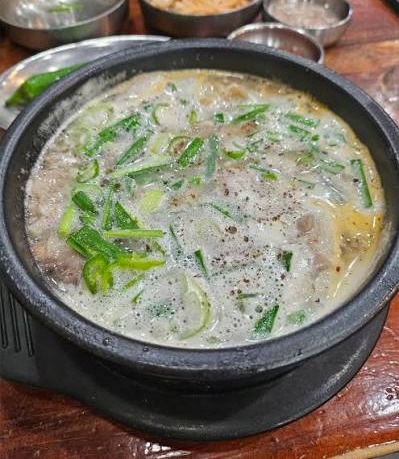
Hold onto that number. When you’re standing in front of any menu in Korea wondering if you’re being overcharged, that’s your benchmark: an honest, filling, sit-down meal — side dishes and water included, no tip — is a low-five-digit number in won.
Rung 1: the convenience store floor — under 2,000 won a piece
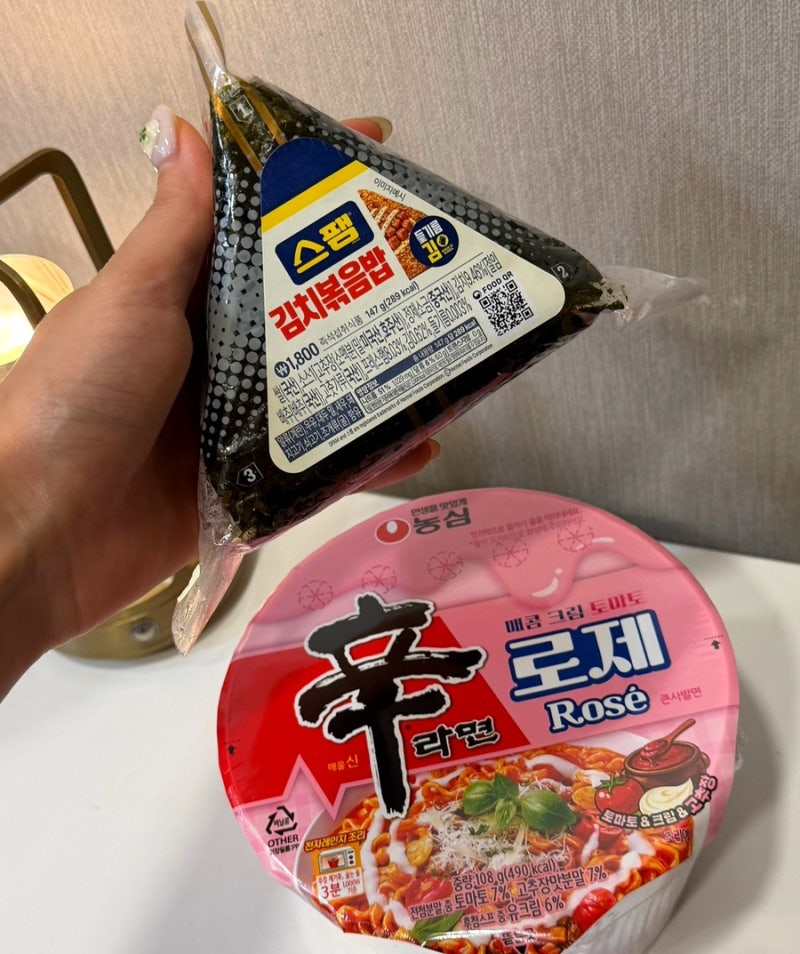
The cheapest real food in Korea is the samgak-gimbap (삼각김밥) — a triangle of seasoned rice and filling wrapped in seaweed. The one in my hand up there is Spam kimchi fried rice: 1,800 won, and the label says exactly what you’re getting — 147 grams, 289 kcal.
The classic move is to pair it with a cup ramyeon, like the Shin Ramyun Rosé big bowl in the same photo, filled from the store’s free hot water dispenser. The pair usually lands around 4,000 won total. Honesty note on that number: the kimbap price is on the label in my photo; the cup’s price isn’t. “About 4,000” is what this combination costs me in practice, not a receipt — I’ll pin it down properly when I photograph one.
One step up from the triangle is the full packaged kimbap roll:
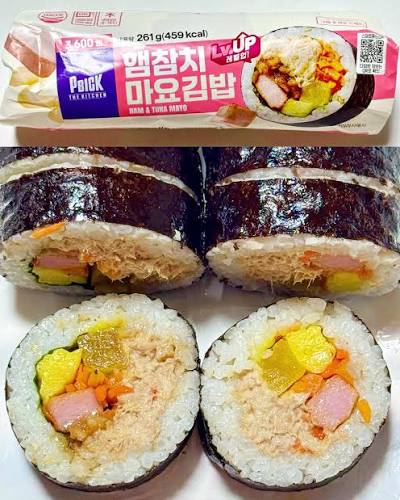
That’s a ham-and-tuna-mayo roll, 261 grams — a legitimate full meal. I’m not quoting a price for this one because the price on my photo is unreadable, and this site doesn’t do “probably.” For scale: when I checked emart24’s official fresh-food listings in late August, full kimbap rolls ran 3,100–3,700 won. Expect that neighborhood.
Two things visitors don’t know: every convenience store is also a dining room — microwave, hot water, chopsticks, usually a counter to eat at — and nobody thinks less of you for eating there. Office workers do it daily. So do I.
Rung 2: the convenience store ceiling — the 6,100 won lunchbox
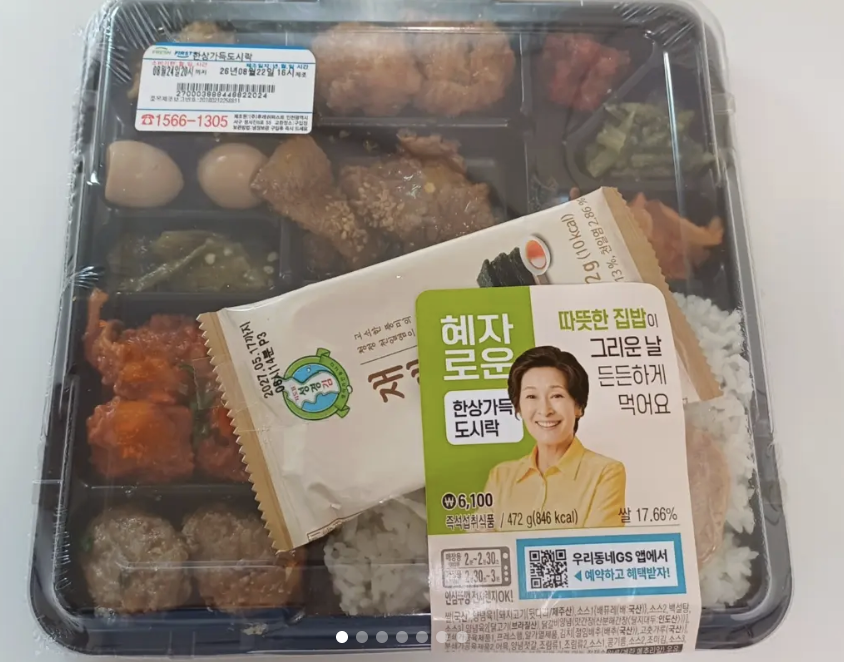
This is the top of the convenience store range, and it’s the item that explains why Koreans take convenience store food seriously: 6,100 won (about $4.44) buys 472 grams and 846 kcal — rice plus a segmented tray of fried chicken pieces, boiled egg, meatballs, and a spread of vegetable sides. Heated in the store microwave, it’s a genuinely square meal.
The name on the wrapper is a small piece of Korean culture. The “Hyeja” (혜자) lunchbox line is named after the veteran actress on the label, and the line became so famous for generous portions that her name turned into slang — calling something hyeja in Korean means it’s surprisingly good value for money. This box is the origin of the expression.
So there’s your convenience store band, photographed: 1,800 won floor, 6,100 won ceiling. A full meal for under $4.50, no exchange-rate gymnastics needed.
Rung 3: the restaurant meal — the 11,000 won bowl
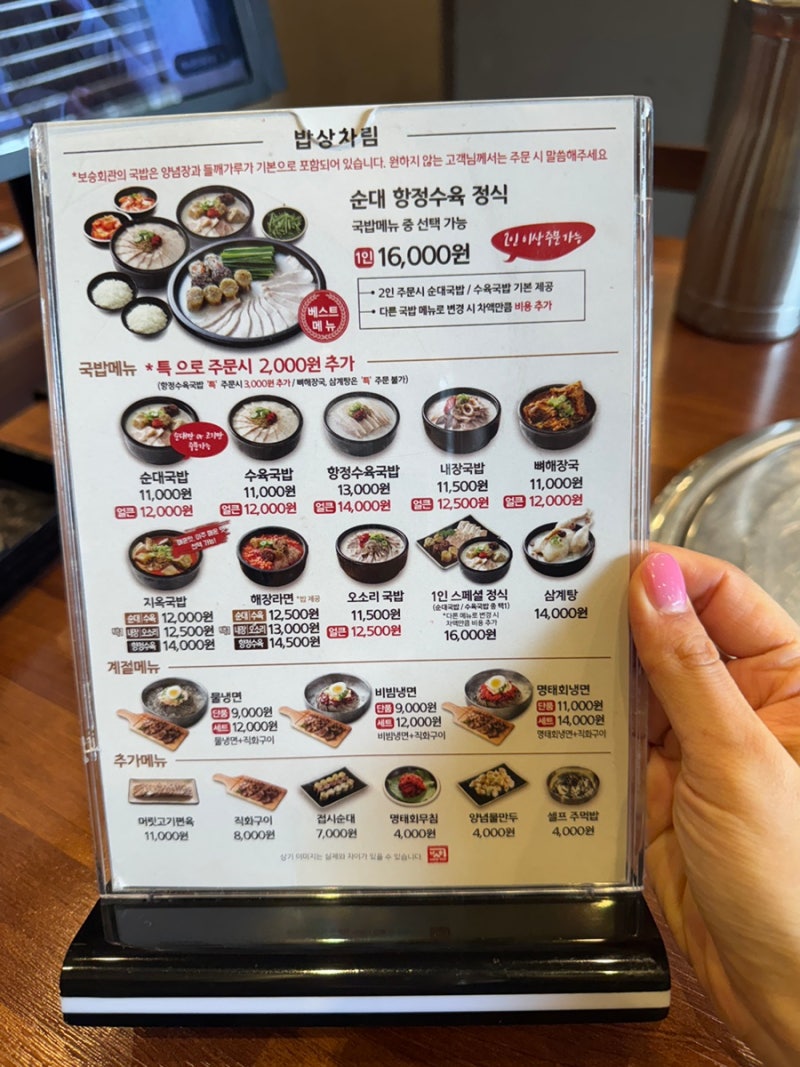
Boseung Hoegwan (보승회관) is a well-known gukbap chain and my personal default. Here’s the board, transcribed — with the caveat that this is one branch’s menu; I haven’t compared other branches, so don’t treat it as a chain-wide price list:
| Bowl | What it is | Won | USD |
|---|---|---|---|
| Sundae-gukbap (순대국밥) | pork soup with Korean blood sausage — the classic | 11,000 | $8.01 |
| Suyuk-gukbap (수육국밥) | pork soup with sliced boiled pork — the bowl photographed above | 11,000 | $8.01 |
| Ppyeo-haejangguk (뼈해장국) | pork spine “hangover soup” | 11,000 | $8.01 |
| Naejang-gukbap (내장국밥) | pork soup with offal | 11,500 | $8.37 |
| Hangjeong suyuk-gukbap (항정수육국밥) | pork jowl version — the upgrade | 13,000 | $9.46 |
| Samgyetang (삼계탕) | whole young chicken and ginseng soup | 14,000 | $10.19 |
| Mul-naengmyeon (물냉면) | chilled buckwheat noodles | 9,000 | $6.55 |
| One-person sundae + pork jowl set (1인 스페셜 정식) | soup plus a plate of sundae and sliced pork | 16,000 | $11.64 |
A few readings off the same board: the spicy version (얼큰) of most bowls adds about 1,000 won; a large (특) adds about 2,000; a plate of sundae to share is 7,000; and self-serve rice balls (셀프 주먹밥) are 4,000. The board also states — in print, at the bottom of the house rules — that every gukbap comes with seasoning paste and perilla seed powder included, which tells you something about how seriously this genre takes its condiments.
What the numbers don’t show, and what makes the $8 bowl better than it sounds:
- Banchan and water are free. Side dishes come with the meal, refills are normal, and water or barley tea appears without being asked and without a charge.
- There’s no tipping and no tax added at the register. The menu number is the whole price — same story as the taxi meter.
- Gukbap shops are the solo diner’s best friend. Counter seating, fast service, nobody blinks at a table for one. This is the answer to Korean BBQ’s two-portion minimums.
Do those prices check out? The government survey says yes
One menu board is one menu board. Here’s the cross-check: the Korea Consumer Agency surveys real Seoul restaurants every month and publishes the averages. The July 2026 Seoul survey:
| Dish | Won | USD |
|---|---|---|
| Jajangmyeon (자장면) — black bean noodles | 7,654 | $5.57 |
| Kimchi-jjigae set (김치찌개백반) | 8,654 | $6.30 |
| Kalguksu (칼국수) — knife-cut noodle soup | 10,038 | $7.31 |
| Bibimbap (비빔밥) | 11,769 | $8.57 |
| Naengmyeon (냉면) — cold noodles | 12,692 | $9.24 |
| Samgyetang (삼계탕) | 18,192 | $13.24 |
My photographed menu sits exactly where it should: the 11,000 won gukbap lands between the surveyed kimchi-jjigae set and bibimbap, and Boseung Hoegwan’s 14,000 won samgyetang actually undercuts the surveyed Seoul average by 4,000 won. Nothing about the benchmark bowl is exotic — roughly 8,000 to 13,000 won is simply what a normal sit-down meal costs in Korea in 2026.
The splurge tier, briefly
Everyday eating is cheap here. The famous stuff is what moves your budget.
Korean BBQ: the same July 2026 survey prices Seoul samgyeopsal (grilled pork belly) at 21,321 won ($15.52) per 200g portion — and nobody stops at one portion. Budget roughly 35,000–40,000 won per person for a proper BBQ night; the meat price is government-surveyed, the extras estimate is experience.
Fried chicken: a whole bird from a major chain runs 19,000–23,000 won, and a chimaek night — chicken and beer for two — came to 29,000 won on an order screen I photographed. That subject has its own posts: Kyochon’s published prices and what to order, and the yangnyeom original at Cheogajip.
Note the shape of this: one BBQ dinner costs more than an entire day of everything above it. Not a reason to skip it — a reason not to do it daily.
A day, added up — every number photographed
- Breakfast: samgak-gimbap — 1,800
- Lunch: sundae-gukbap, sides and water included — 11,000
- Dinner: GS25 lunchbox — 6,100
18,900 won. About $13.76. Three real meals, one of them a sit-down soup with banchan, and every price in that list is on a label or menu board photographed above — no averages, no “usually costs.”
Want all three meals in restaurants? At the surveyed Seoul averages — jajangmyeon, bibimbap, kalguksu — you’re at 29,461 won, about $21. Add a cup ramyeon here and a coffee there and the honest planning range for a non-BBQ day is $14–25. Food will probably be the smallest major line in your Korea budget — getting in from the airport costs less than the gukbap if you do it right.
What I couldn’t verify
Playing by this site’s rules — no source, no number:
- The cup ramyeon price. The 4,000 won kimbap-plus-ramyeon figure is my everyday experience; the ramyeon’s price tag isn’t in my photo. Receipt coming.
- The ham-and-tuna kimbap price. The sticker in my photo is unreadable, so that roll appears here without a number.
- Whether Boseung Hoegwan’s prices are chain-wide. I photographed one branch’s menu. Korean chains let branches vary; treat the table as one real data point, not a national price list.
- Whether 1,800 won is typical for samgak-gimbap. That’s one product’s label. Plainer triangles sell for less, premium ones for more, and no chain publishes the range on the open web.
- Café prices. Mega Coffee, Compose, Paik’s, Starbucks Korea — none publish menu prices online. I’ll add numbers when I photograph a menu board.
- The 1,000 won bowl of rice (공기밥), street food, and restaurant receipts to pair with the meals — all still on the shooting list.
If you’ve got a dated Korean receipt or menu photo that contradicts anything here, send it — I’d rather be corrected than have you plan around a stale number.
The rest of this series
- Korean fried chicken: real chain prices and what to order — the 20,000-won national grievance, itemized.
- Yangnyeom chicken at Cheogajip — the sweet-spicy one, and the chibap move nobody tells visitors.
- Incheon Airport to Seoul for 5,000 won — the train that costs one-twelfth of the taxi.
- Seoul taxis without getting ripped off — meter rates and the app that keeps them honest.
Common questions
How much does food cost per day in Korea?
A realistic budget day, built entirely from photographed prices: a 1,800 won triangle kimbap for breakfast, an 11,000 won bowl of suyuk-gukbap for lunch, and a 6,100 won convenience store lunchbox for dinner — 18,900 won, about $14. Eating every meal in sit-down restaurants runs closer to $21–22 a day at government-surveyed Seoul averages. Korean BBQ night is the main thing that pushes a day past $30.
How much is a meal at a normal restaurant in Korea?
A bowl of gukbap — the soup-with-rice standard of everyday Korean eating — ran 11,000 to 14,000 won (about $8–10) on a menu photographed at a well-known soup chain in late summer 2026, side dishes and water included, no tip. Government-surveyed Seoul averages from July 2026 put a kimchi-jjigae set at 8,654 won and bibimbap at 11,769 won, so roughly $6–10 is the honest range for a normal restaurant meal.
What is gukbap and why does it matter for a Korea budget?
Gukbap (국밥) is soup with rice — pork broth, blood sausage or sliced pork, a bowl of rice, side dishes included. It matters because Koreans use it as a price benchmark: the cost of an ordinary working lunch is commonly talked about as the price of a bowl of gukbap. If you know a bowl runs about 11,000 won right now, you know what lunch costs in Korea.
Is Korean convenience store food actually good?
Yes, and Koreans eat it constantly — it isn't a tourist novelty or a last resort. A triangle kimbap runs under 2,000 won, packaged kimbap rolls a bit over 3,000, and a full hot lunchbox with rice and eight-plus side dishes about 6,100 won. Every store has a microwave and hot water, and eating there is completely normal.