Jeju Bus Fares From the Airport: Jeju Without a Car, Priced
A Jeju city bus costs $0.86 (1,150 won) by card, and an express bus from the airport to the far side of the island tops out at $2.25 (3,000 won). The airport's own taxi estimate to Jungmun is 35,000 won.
Prices checked November 18, 2026 · in Seoul, on screen
A Jeju city bus costs $0.86 (1,150 won) with a transit card. An express bus from Jeju International Airport starts at $1.50 (2,000 won) and stops charging at $2.25 (3,000 won), however far you ride. That cap covers the trip to Seongsan, Pyoseon or Seogwipo. The airport limousine to the Jungmun resort hotels and Seogwipo costs between $0.97 and $4.12 (1,300 to 5,500 won). For comparison, the airport’s own taxi estimate to Jungmun is $26.19 (35,000 won).
I live in Seoul, and Jeju is where Seoul people fly for a long weekend. Most of them rent a car at the airport. If you don’t drive in Korea, or would rather not, the island’s buses go almost everywhere a visitor wants to go. They are cheap. They are also infrequent outside Jeju City, and that matters more than the fare. This guide gives you the published numbers and the stop you need at the airport.
Checked online on November 18, 2026 (Checked: 2026-11-18). Bus fares and transfer rules come from the Jeju Bus Information System fare page, run by Jeju Special Self-Governing Province. Taxi meter rates come from the same system’s taxi page. Airport stops, timetables and taxi estimates come from Jeju International Airport’s bus, limousine and taxi pages. This is a guide to published prices checked on screen, not a ride log or a receipt. Dollar figures use $1 = 1,336.21 won (ECB reference rate for November 17, 2026, via Frankfurter). They are approximate conversions, not a card or cash-exchange quote.

The short version
| Ride from the airport | Adult card fare | In dollars | Note |
|---|---|---|---|
| City bus (into Jeju City) | 1,150 won | $0.86 | Flat fare |
| Express bus, first 20 km | 2,000 won | $1.50 | Charged when you board |
| Express bus, longest trips | 3,000 won | $2.25 | The cap |
| Limousine 600 (Jungmun, Seogwipo) | 1,300–5,500 won | $0.97–$4.12 | By stop |
| Limousine 800 (Seogwipo terminal) | 1,300–5,000 won | $0.97–$3.74 | By stop |
| Taxi to Jeju City Hall (airport estimate) | 9,000 won | $6.74 | About 30 minutes |
| Taxi to Jungmun (airport estimate) | 35,000 won | $26.19 | About 80 minutes |
The bus fares come from the province’s table. The taxi figures are the airport’s estimates, not meter readings.
Where the buses leave from at Jeju Airport
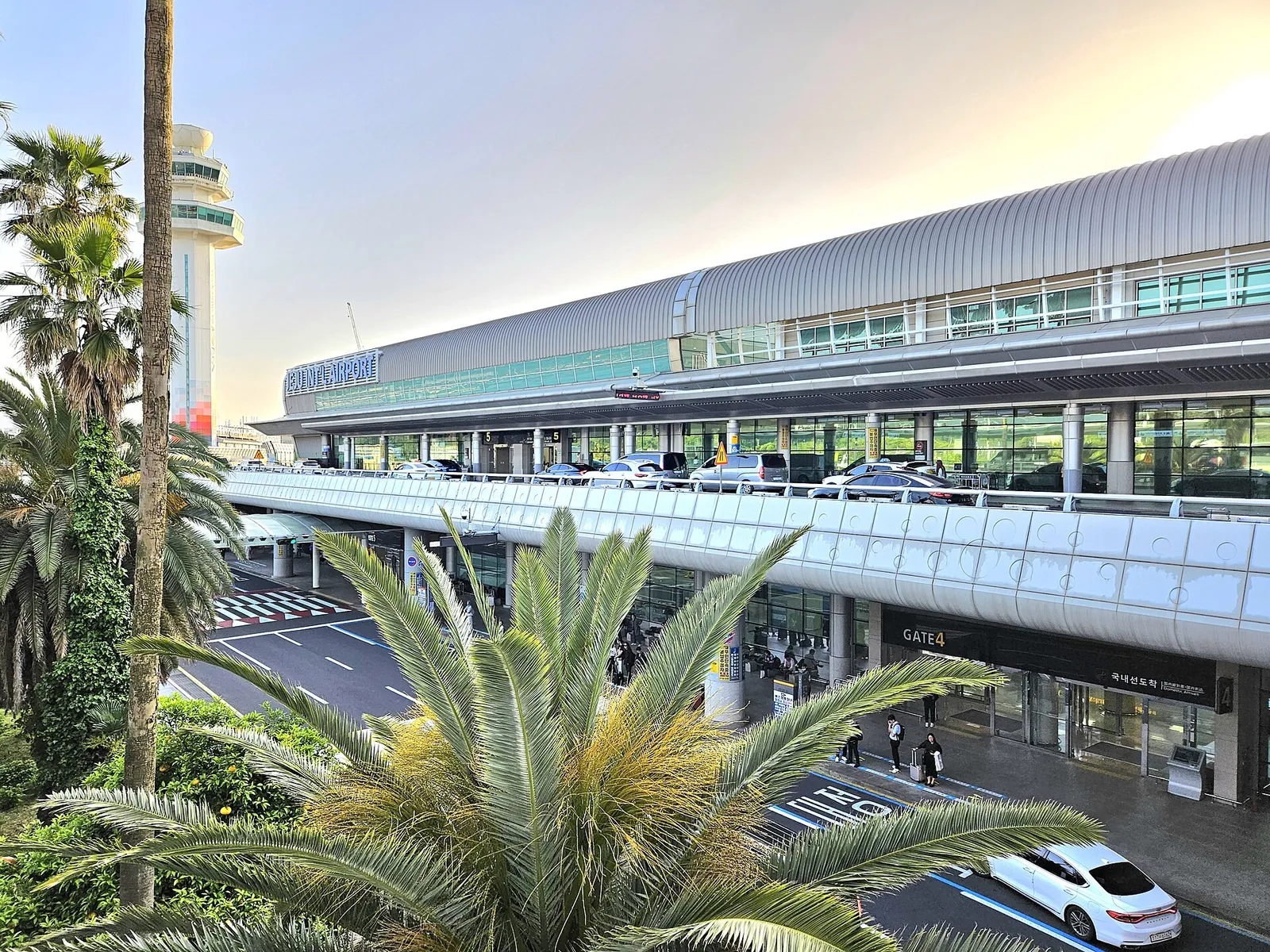
Every bus leaves from the curb outside the arrivals hall. The airport numbers the doors as gates, and its bus page groups the routes by stop. Here is the version that matters to a visitor:
- Gate 1: express buses heading east and south-east. Route 111 to Seongsan Port, 101 along the east coast to Namwon, 121 and 122 to Pyoseon, 131 and 132 to Namwon, and 181 over the 5·16 road to Seogwipo.
- Gate 2: city buses toward Yongdam and Jeju City Hall, and express 102 along the west coast to Moseulpo.
- Gate 4: express 182 over the Pyeonghwa-ro road to Jungmun and Seogwipo, express 151 to Moseulpo, and limousines 800 and 801.
- Gate 5: limousines 600 and 601, and city buses toward Nohyeong and Yeon-dong.
Two things trip people up. First, the same route number can stop at two gates, one for each direction. Second, the airport splits Jeju City buses between Gate 2 and Gate 5 by area, so check which side of town your hotel is on.
City buses: one flat fare
Jeju’s regular buses are called 간선 (trunk) and 지선 (branch) buses. Their route numbers start with 2, 3, 4, 5 or 6, plus the 7xx routes that serve the villages. The province’s fare table lists one flat adult fare for all of them:
| Rider | Card | Cash |
|---|---|---|
| Adult (19 and over) | 1,150 won ($0.86) | 1,200 won ($0.90) |
| Teen (13–18) | 850 won ($0.64) | 900 won |
| Child (6 to under 13) | 350 won ($0.26) | 400 won ($0.30) |
The same fare applies to the tourist circulation buses, the 810 and 820 loops. These run around inland sights from the Daecheon and Donggwang transfer stops.
A teen or child discount only works on a registered card. The province says you must buy the prepaid card and then register the rider’s age with the card company before the lower fare applies. A visitor’s unregistered T-money charges the adult fare.
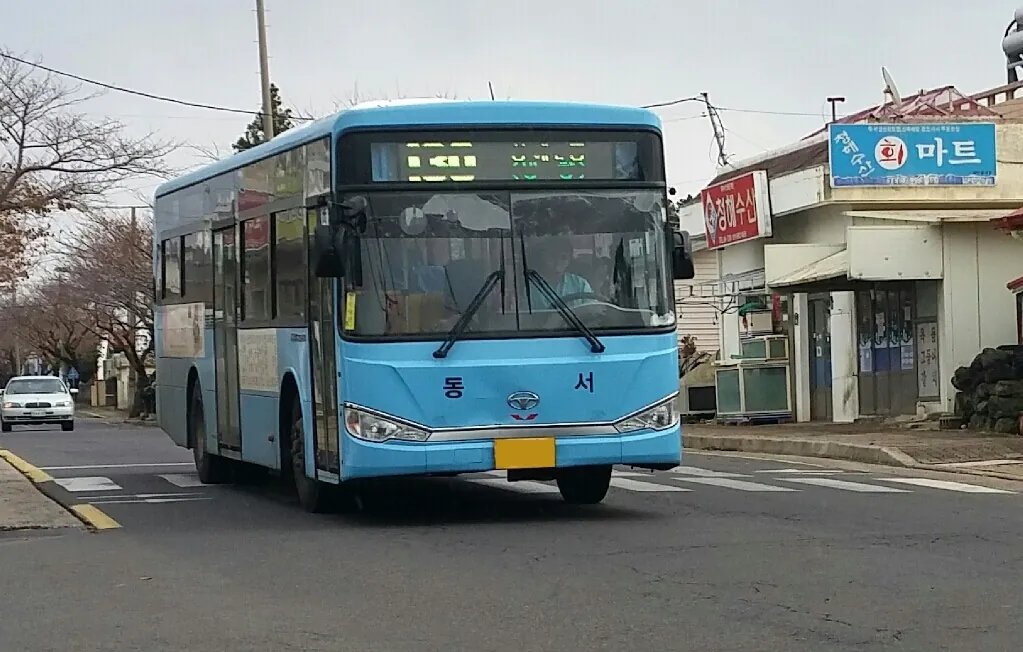

From the airport, a city bus is the right choice for anywhere in Jeju City itself: the old downtown, the bus terminal, Nohyeong or the ferry port. The airport lists route 365 to City Hall and Jeju National University every 11 to 21 minutes on weekdays.
Express buses: 2,000 won to start, 3,000 won at most
Express buses (급행버스) have route numbers in the 100s. They are how you cross the island without a car. They stop less often, and they charge by distance.
The fare table works like this for an adult with a card:
- When you board: 2,000 won ($1.50). That covers the first 20 km.
- When you tap off: a distance charge on top. It is 200 won for 5 km more, 400 won for 10 km, 600 won for 15 km, 800 won for 20 km and 1,000 won beyond that.
- The cap: 3,000 won ($2.25), reached on trips over 40 km.
Teens pay 1,600 won at boarding and 2,400 won at most. Children pay 1,000 won and 1,500 won at most.
In practice, the long airport routes to Seongsan, Pyoseon, Namwon, Moseulpo and Seogwipo are where the cap is likely to apply. The province does not print a fare for each pair of stops, so the exact charge for your trip shows up on the reader when you tap off.
Tap off, every time
The distance charge is taken when you get off. So you need to tap your card again as you leave. The province’s table also says the cash fare on an express bus is always the maximum. The airport’s route notes, though, say these buses haven’t accepted cash since July 2024 (more on that below).

Which express bus goes where
These are the airport’s listings for the routes a visitor is most likely to need. Times are first and last departures from the airport, as published.
| Route | Gate | Goes to | First–last | Gap |
|---|---|---|---|---|
| 111 | 1 | Seongsan Port, via Songdang | 06:50–21:30 | 40–77 min |
| 101 | 1 | East coast: Hamdeok, Woljeong, Seongsan, Namwon | 06:55–21:38 | 30–120 min |
| 181 | 1 | Seogwipo over the 5·16 road | 06:40–22:15 | 40–60 min |
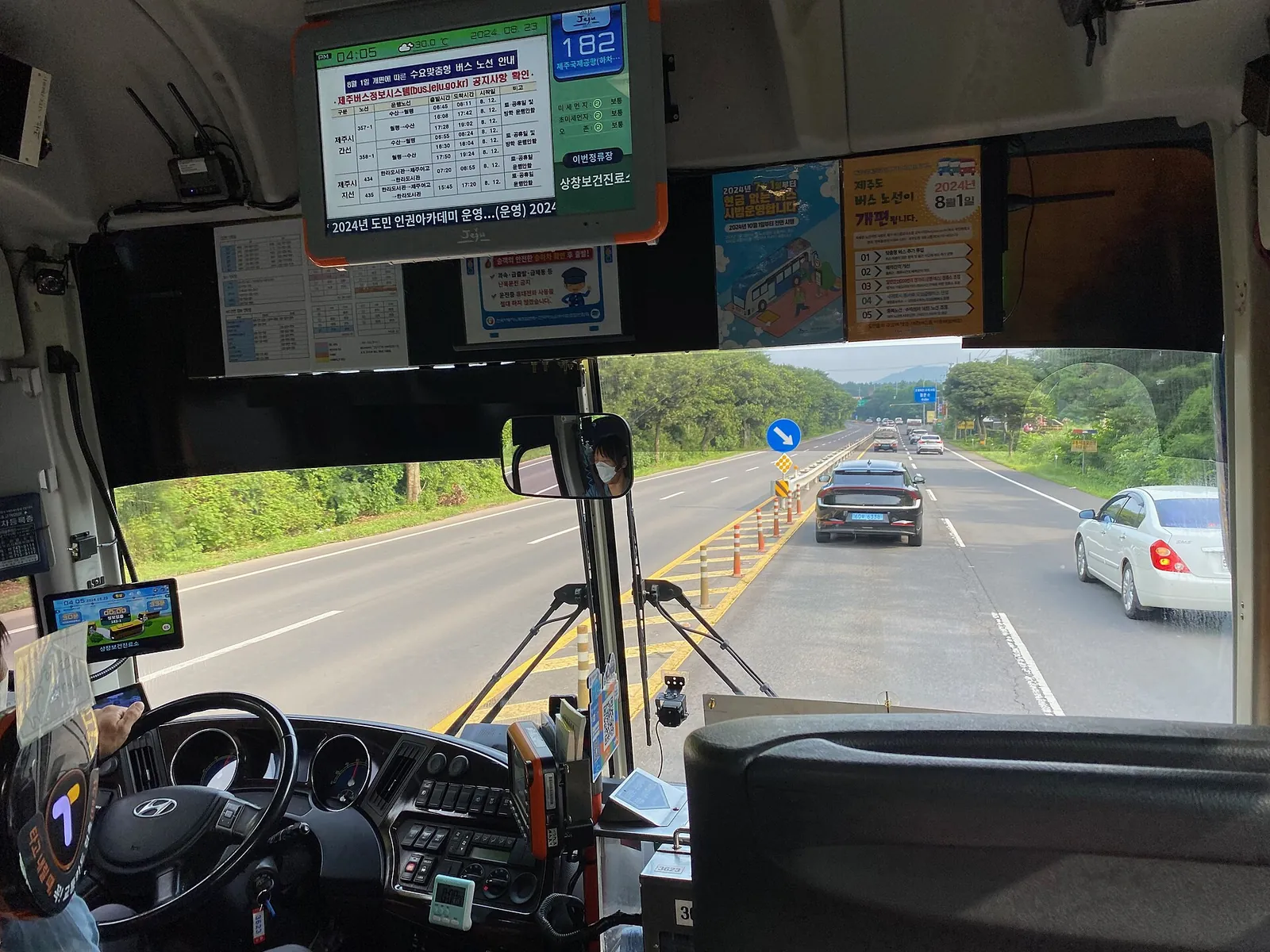
| 182 | 4 | Jungmun and Seogwipo over Pyeonghwa-ro | 06:45–21:30 | 30–60 min |
| 102 | 2 | West coast: Aewol, Hallim, Moseulpo | 06:55–21:35 | 25–55 min |
| 151 | 4 | Moseulpo via Donggwang and Osulloc | 06:50–21:45 | 30–70 min |
Look at the gap column before you plan a day. An hour between buses is normal once you leave Jeju City. Miss the last bus back from Seongsan and the only way home is a long taxi ride.
The airport limousines: 600 and 800
Jeju has two airport limousine lines. Their fares are set by stop, not by the express formula. The province lists the adult ranges:
- Route 600: 1,300 to 5,500 won ($0.97 to $4.12). It runs from the airport to the Jungmun resort hotels, the convention center, the World Cup Stadium and the Seogwipo KAL Hotel. It leaves from Gate 5.
- Route 800 (and 800-1): 1,300 to 5,000 won ($0.97 to $3.74). It runs from the Jeju bus terminal through the airport to the Seogwipo bus terminal. It skips Jungmun and leaves from Gate 4.
The full per-stop fares sit in a downloadable spreadsheet, not on the page itself. In that spreadsheet, the top fare on route 600 is the ride from the airport to the far end in Seogwipo. The stops in between cost less.
The airport’s limousine page lists route 600 from 06:30 to 22:20, every 16 to 40 minutes. Its value is the stop list, not the price. Route 600 stops at the big Jungmun resort hotels by name. Express 182 also goes to Jungmun and costs no more than 3,000 won, but it stops at the Jungmun post office in town, not at the resort. If you have a large suitcase and a hotel in the resort area, the limousine saves you the walk.
Transfers: 40 minutes, two changes
The second bus is often free in Jeju. The province’s rules say:
- Window: board the next bus within 40 minutes of tapping off the first one.
- Limit: up to two transfers per trip.
- Same route doesn’t count. The same route number in the other direction gets no discount either.
- What you pay: nothing extra if the next bus costs the same or less. If it costs more, you pay only the difference.
The province gives these adult examples:
| Trip | First bus | Second bus | Total |
|---|---|---|---|
| City bus, then city bus | 1,150 won | 0 won | 1,150 won ($0.86) |
| City bus, then express | 1,150 won | 850 won | 2,000 won ($1.50) |
| Express, then city bus | 2,000 won | 0 won | 2,000 won ($1.50) |
| Express, then express | 2,000 won | 850 won | 2,850 won ($2.13) |
Express-to-express is the exception. The second express bus is discounted by only 1,150 won, not by its full fare. Any distance charge on an express bus is also added when you tap off, transfer or not.
This is why you tap off on a city bus too. The 40-minute window starts at the tap.
Cash, cards and T-money
The province’s table still prints cash fares, and its card section says a card saves 50 won over cash on city and village buses. But each route in the airport’s listings carries the same note: no cash since July 2024. I’d treat the airport’s note as the one to plan around and carry a card.
The province says any nationally compatible prepaid card works. It names T-money (티머니), Cashbee, Mybi and others, and says you can buy and top them up at convenience stores. If you already have a T-money card from Seoul, it works on Jeju buses. Korean credit cards with a transit function also work. The province page doesn’t mention foreign credit cards.
Checking bus times and live bus locations needs data, so sort out a SIM or eSIM before you land. Our SIM and eSIM guide prices the options.
The taxi, for comparison
Jeju taxis run on a meter. The province’s taxi page lists these mid-size taxi rates, in effect since July 1, 2024:
- Base fare: 4,300 won ($3.22) for the first 2 km.
- Distance: 100 won per 126 m after that, or 100 won per 31 seconds when moving at 15 km/h or less.
- Long trips: 120 won per 126 m beyond 20 km.
- Late night: 20% extra from 11 p.m. to 4 a.m.
- Calling a taxi: 1,000 won ($0.75) per call, where the taxi charges it.
The airport’s taxi page turns that into estimates for a regular taxi:
| Destination | Time | Estimated fare |
|---|---|---|
| Jeju City Hall | 30 min | 9,000 won ($6.74) |
| Aewol | 55 min | 25,000 won ($18.71) |
| Hallasan | 60 min | 30,000 won |
| Jungmun resort area | 80 min | 35,000 won ($26.19) |
| Seongsan | 100 min | 45,000 won ($33.68) |
A deluxe taxi (모범택시) costs more. The airport puts Jungmun at 63,000 won ($47.15). The page gives no date for these estimates.
Here’s the comparison that matters. To Jungmun, a taxi for one person is roughly twelve times the express bus fare. For three or four people with luggage, splitting 35,000 won narrows the gap a lot. The same logic applies at Incheon, which we priced in Incheon Airport to Seoul. Jeju taxis follow their own meter, but the habits in our Seoul taxi guide carry over: check that the meter is on, and know the night surcharge hours.
So, is Jeju without a car realistic?
On cost, easily. Every ride in this guide except the limousine and the taxi is 3,000 won or less by card. A day of three express rides, without transfer discounts, is 9,000 won ($6.74) at most.
On time, it depends on where you stay. Here is how I’d think about it:
- Base in Jeju City or Seogwipo. Both have frequent city buses, and both are hubs for the express routes. A day trip from either is simple.
- Pick one coast per day. The east (Hamdeok, Woljeong, Seongsan) is on routes 101 and 111. The west (Aewol, Hallim, Gosan) is on route 102. Crossing from one to the other means a transfer and a long ride.
- Check the last bus before you leave. On most express routes, the last departure from the airport is between 9:30 and 9:45 p.m. Route 181 runs until 10:15 p.m. The last bus back from a far coast may leave earlier, so check the timetable for the return trip too.
- Expect waits. The airport’s own listings show gaps of 40 to 77 minutes on route 111, and up to two hours on route 101.
If your list is Hallasan trailheads, the big sights near Seongsan and Jungmun, and a beach or two, the bus works. If it’s small cafes on farm roads, a car or the occasional taxi is the honest answer.
What I couldn’t verify
- Exact express fare for a specific trip. The province publishes the distance bands but not a fare for each pair of stops. The reader shows the charge when you tap off.
- What happens if you don’t tap off an express bus. The fare table doesn’t say whether you are charged the maximum.
- Per-stop limousine fares. These are only in downloadable spreadsheets, so this guide gives the published ranges.
- Cash. The province still lists cash fares; the airport says no cash since July 2024. I couldn’t find a single official statement that settles which applies on every route.
- Night bus 3001 fare. The airport lists this airport loop at 1,150 won in one place and 1,250 won in another.
- Date of the airport’s taxi estimates, and whether they include tolls or waiting time.
- Foreign credit cards. Whether overseas contactless cards work on Jeju bus readers isn’t stated on either site.
Related guides
Common questions
How much is the bus from Jeju Airport?
A regular city bus costs 1,150 won (about $0.86) with a transit card. Express buses (numbers in the 100s) start at 2,000 won ($1.50) and add a distance charge when you tap off, up to 3,000 won ($2.25). The airport limousines charge 1,300 to 5,500 won on route 600 and 1,300 to 5,000 won on route 800. These are Jeju's published adult fares, checked November 18, 2026.
Can you get around Jeju without a car?
Yes, if you plan around the timetable. Express buses leave the airport for Seongsan, Pyoseon, Namwon, Moseulpo, Jungmun and Seogwipo, and no single ride costs more than 3,000 won by card. The catch is frequency: the airport lists gaps of 40 to 77 minutes on route 111 to Seongsan, and on most express routes the last bus leaves the airport between 9:30 and 9:45 p.m.
Do Jeju buses take cash?
Don't count on it. The Jeju bus information system still prints cash fares (1,200 won on a city bus), but the airport's route listings say cash has not been accepted since July 2024. Use T-money or another Korean transit card.