Yangnyeom Chicken: The Sweet-Spicy One, and Where to Actually Get It
The red sauce is what most people picture when they say Korean fried chicken. What it actually is, what it costs, why Cheogajip is the shop I send people to — and the two things Koreans do with a chicken order that no guide tells you.
Prices checked August 21, 2026 · in Seoul, on screen
Ask someone who has never been to Korea to picture Korean fried chicken and they will describe yangnyeom. The red one. Sticky, glossy, sweet with a warm edge of heat, the sauce getting on everything including you.
That’s the one. And it’s the one I told you not to order at Kyochon.
So here’s the follow-up I promised: what yangnyeom actually is, where I’d send you for it, why the price is impossible to look up in advance — and the two things Koreans do with a chicken order that nobody tells visitors about.
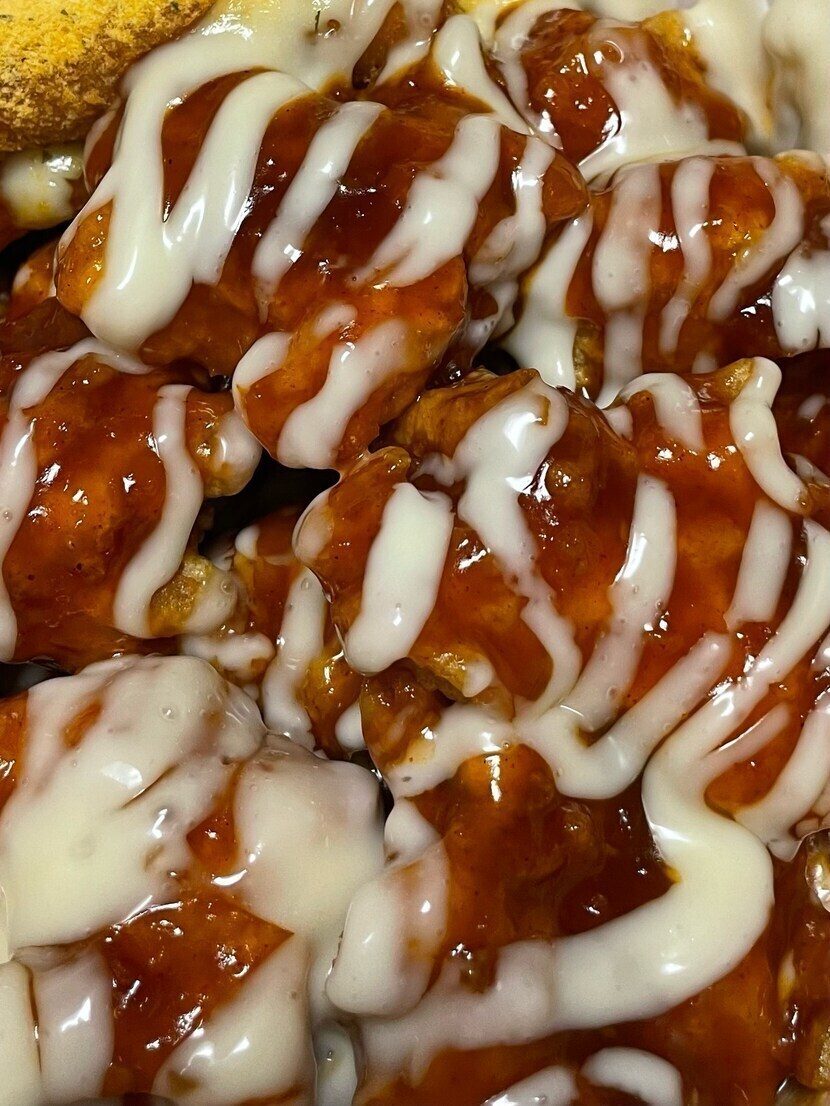
What yangnyeom actually is
Yangnyeom (양념) just means “seasoning” or “sauce” in Korean. In a chicken shop it means one specific thing: fried chicken tossed in a red sauce built on gochujang, Korea’s fermented chili paste, cut with sugar, garlic, and usually corn syrup or ketchup for gloss.
Two things surprise first-timers.
It’s sweeter than it is spicy. People brace for heat and get candy-adjacent. Standard yangnyeom is sweet up front with a low warm burn arriving late — if you can eat sriracha, you can eat this without noticing. Shops sell separate hot versions precisely because the standard one isn’t.
It’s not crunchy, and it isn’t supposed to be. The sauce goes on hot and the crust softens under it within minutes. That’s the trade. If crunch is what you want, that’s plain fried (후라이드) or soy garlic. Yangnyeom is a sauce dish that happens to be built on fried chicken.
This is also why yangnyeom travels badly. Order it for delivery, get stuck in traffic, and what arrives is soft. Locals know this. It’s part of why the half-and-half order exists.
Why Cheogajip
There are hundreds of chicken chains here and almost all of them sell a yangnyeom. The reason I point people at Cheogajip (처갓집) is that yangnyeom isn’t a menu item there — it’s the entire identity. The brand name literally ends in yangnyeom chicken. They’ve been doing this since the 1980s, one of the first-generation chains from the era when yangnyeom went national.
Worth being honest about one thing: you’ll see claims that Cheogajip invented yangnyeom chicken. Don’t repeat them as fact. Mexicana and Pelicana make the same claim, the sources contradict each other on dates, and there’s no settled answer. What isn’t in dispute is that Cheogajip is one of the originals and has never been known for anything else.
They’re around 1,250 stores nationwide, which means there’s likely one near wherever you’re staying. That matters more than it sounds — a lot of the best chicken advice you’ll read points you at single-location shops you’ll never realistically get to.
The supreme drizzle
Here’s the actual reason to go, and the thing that makes their chicken identifiable across a room.
Their signature is supreme yangnyeom (슈프림 양념치킨). The red sauce goes on as normal. Then a second, pale, creamy sauce is applied over the top — drizzled in thin lines rather than tossed through. Nothing gets stirred together. You end up with red underneath, white lines on top, and both flavors arriving separately in the same bite: sweet-spicy, then cool and creamy against it.
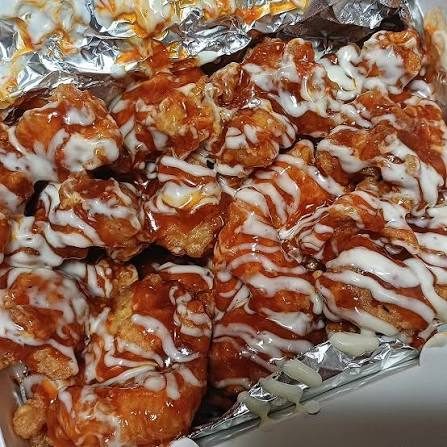
The company says the supreme line passed 100 million birds sold as of March 2024, measured by sauce shipped. Take the exact figure as company-reported, but the scale is real — this is a genuinely mainstream Korean thing, not a novelty.
You can see it in how Koreans rank chicken, too. On one Korean chicken ranking board, truffle supreme yangnyeom sits at #10 nationally — against every product from every chain in the country, in a market with hundreds of brands.
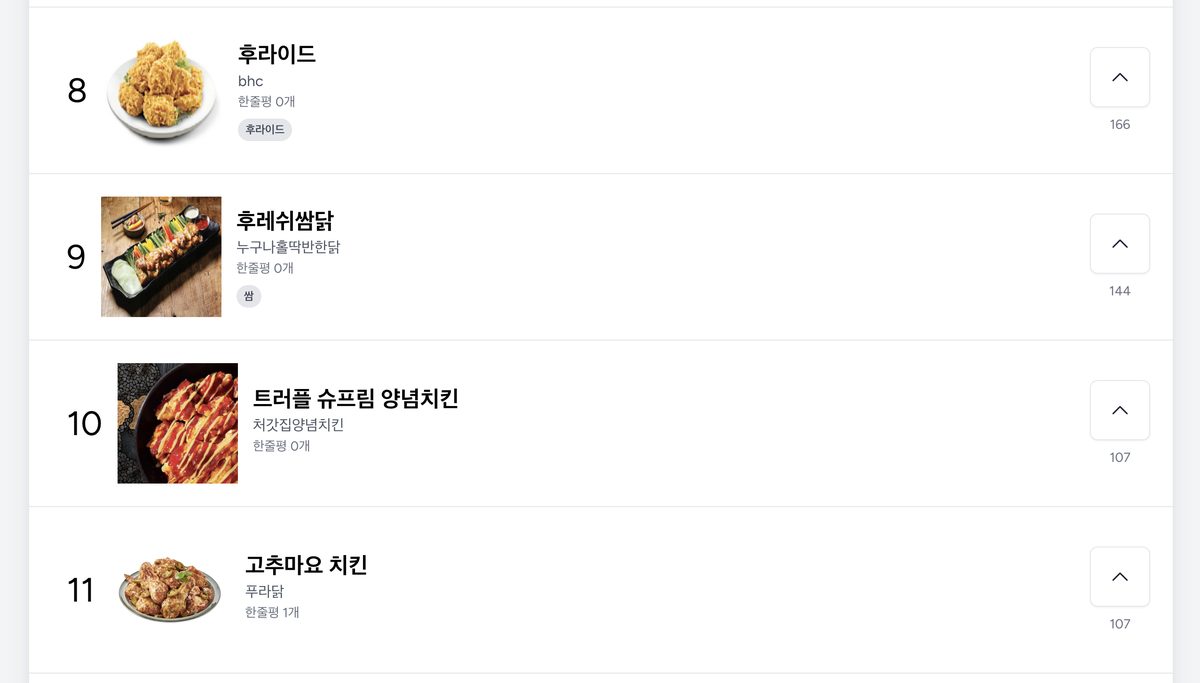
If you order one thing here, order that.
What it costs — and why nobody can tell you in advance
Now the part that surprised me while writing this.
Cheogajip does not publish its prices anywhere. Not on the official site, not on the menu page. I went and checked: the official menu page lists every product they sell — fried, half-and-half, the whole supreme line, the white-meat range — and not one price.
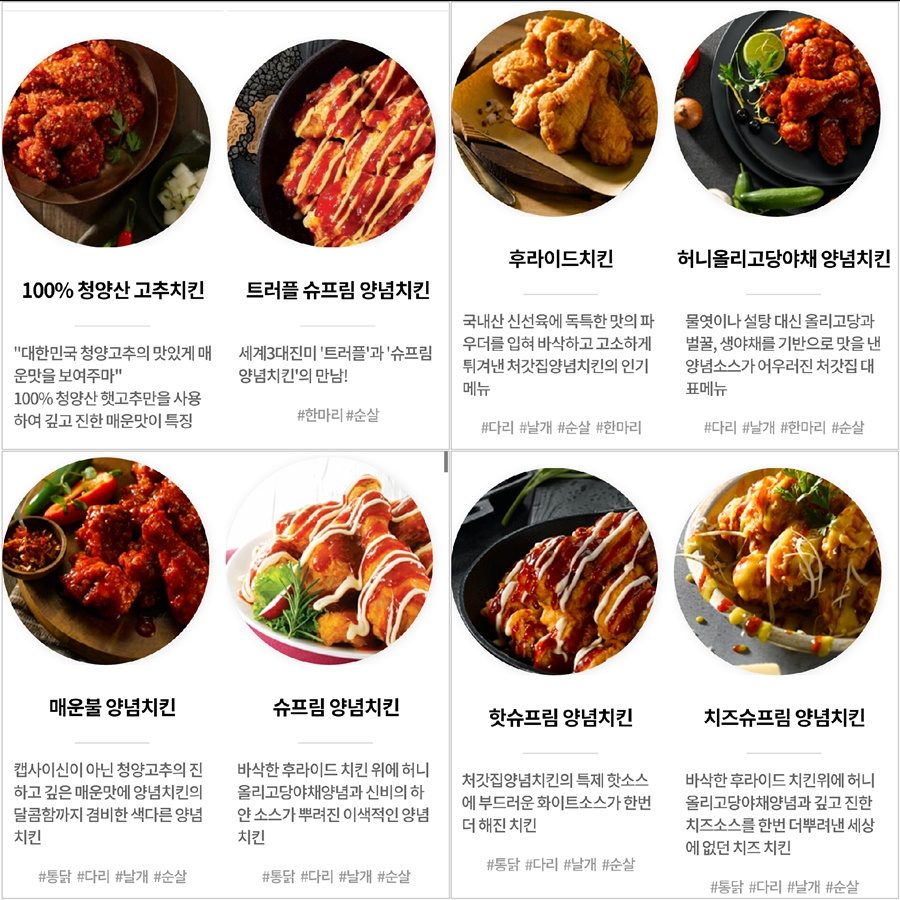
This is a real difference from Kyochon, which publishes a national recommended price list you can read before you leave the house. I quoted those numbers directly in the Kyochon guide. I can’t do that here.
So be warned about something: every “Cheogajip price list” you’ll find in English is either copied from an old blog post or invented. I found figures floating around that trace back to 2020. Korean chicken prices have moved a lot since 2020 — there’s a running national argument about birds crossing the 20,000 won line — so those numbers aren’t just stale, they’re misleading.
What I’ll give you instead is what I actually saw, with a date and a location on it.
| What you order | Won | USD |
|---|---|---|
| Supreme yangnyeom, whole chicken — delivered | 23,000 | $16.53 |
This is a delivery price, paid August 2026. Exchange rate: $1 = 1,391 won — the same rate used in the Kyochon guide, so the two are directly comparable.
That’s above Kyochon’s soy garlic at 19,000 won and at the top of the normal chain band. It is not a bargain and it is not a rip-off — it’s what a name-brand bird costs in Korea now.
But 23,000 is close to the worst price you can pay for this chicken, and that needs explaining.
How to not pay 23,000 won
Korean chicken pricing has a gap between the sticker price and what people actually pay, and almost no foreign visitor knows about it. Three things move the number:
1. Takeout is cheaper — and it’s only advertised on the window
Most Cheogajip storefronts run a takeout discount, typically 2,000 won off. Not on any app, not on the website. It’s printed on the glass.
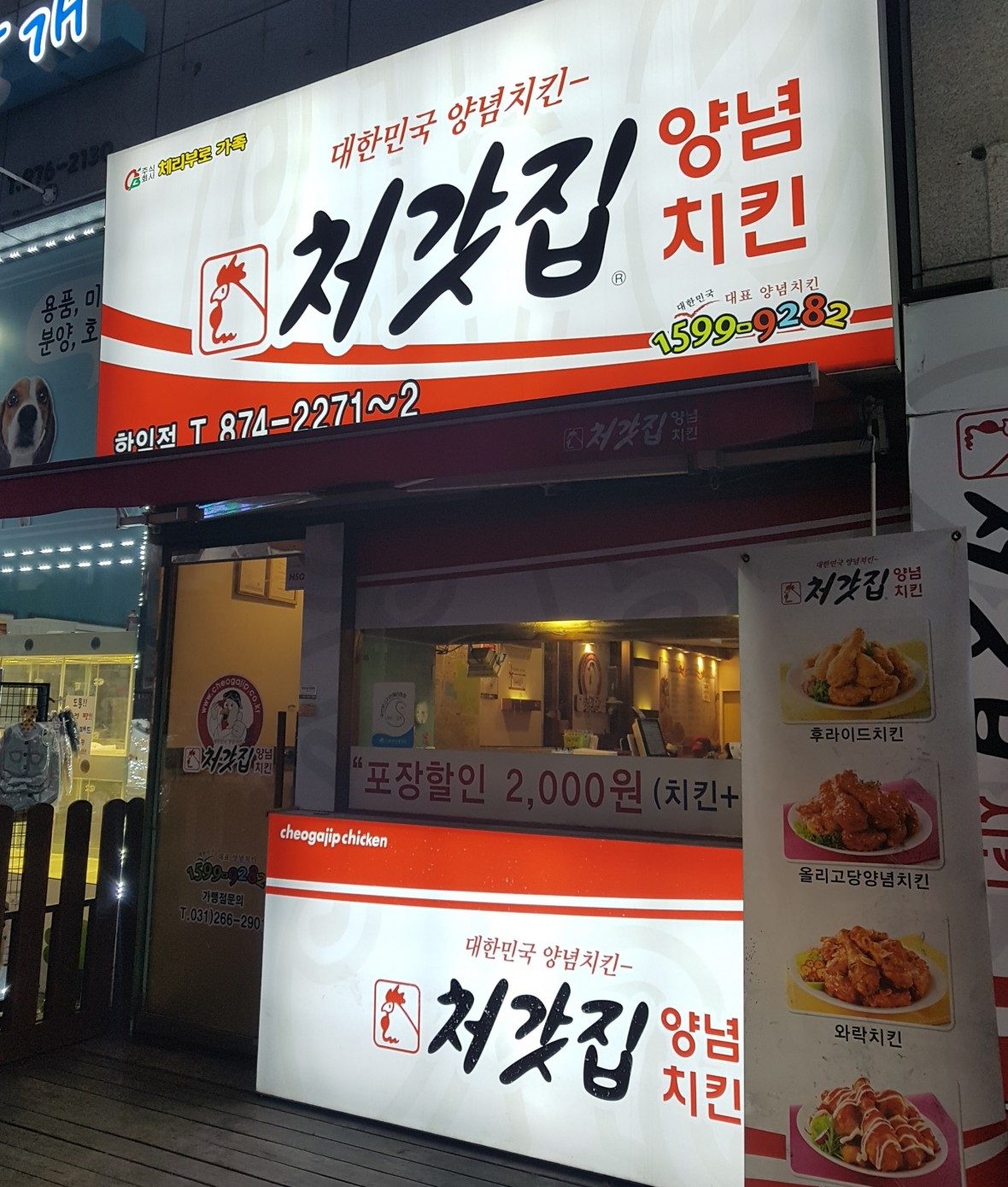
There’s a second reason to walk: yangnyeom degrades in transit. Sauce on hot crust for twenty minutes in a sealed box means soft chicken. Picking it up gets you a better bird and a lower price.
2. Delivery apps run constant coupons
Baemin (배달의민족), Coupang Eats and Yogiyo run promotions more or less permanently — first-order coupons, store-specific discounts, free-delivery thresholds. The same chicken can swing several thousand won depending on which app you open and what’s running that day.
Check more than one app before ordering. Koreans do this reflexively.
3. Have a Korean friend order it
Being blunt: Korean delivery apps are hard for visitors. They generally want a Korean phone number for verification, a Korean payment method, and the interface is Korean-first. Foreign cards are hit and miss.
If you have a Korean friend, colleague, exchange buddy, or host — ask them to order. It takes them ninety seconds, they’ll know which app has a coupon running, and it removes the whole verification problem. This isn’t an imposition here; food is social and ordering for the group is normal.
No Korean contacts? Walk in and point. Takeout is cheaper anyway, and a chicken shop transaction needs about four words (see below).
The two things Koreans do with it that you won’t think of
This is the part no English guide will tell you, and it’s the reason a chicken order here isn’t just a chicken order.
Chibap (치밥) — rice in the leftover sauce
When the chicken is gone, the sauce isn’t. There’s a layer of red-and-white glaze pooled in the bottom of the box, and throwing it out is considered a small crime.
Chibap is chi(cken) + bap (rice). You get a bowl of rice — from the shop, from a convenience store, from the hotel room, doesn’t matter — and you work it through what’s left in the box until the sauce is gone.
It sounds like a joke and it is completely standard. Ask any Korean. The supreme sauce is especially good for it because the creamy drizzle stops the gochujang from being purely sweet-hot, so it behaves more like a sauce for rice than a candy glaze.
If you order takeout, ask for 밥 (bap) — many shops sell a rice portion for a small amount, and Cheogajip has a rice item on the menu outright.
Chicken with buldak ramen
The current pairing is buldak (불닭) — the extremely spicy stir-fried instant noodles — eaten alongside the chicken.
The logic is better than it sounds. Yangnyeom is sweet with a mild warm heat. Buldak is aggressive, dry, actually hot. You alternate: sweet, then fire, then sweet again. Each one resets your mouth for the other, and neither gets boring the way a whole bird of one flavor does.
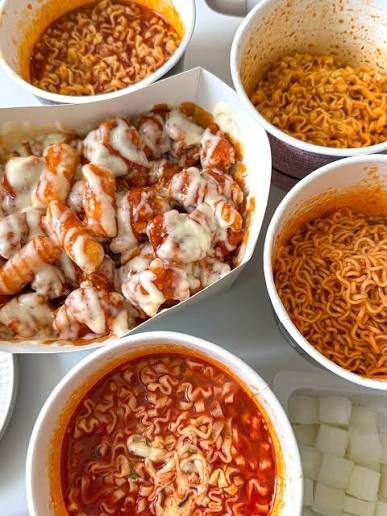
If you want to do this: buldak comes in cups and packets in every convenience store in Korea, costs about 1,500 won, and comes in heat levels. The standard red one is already very hot by non-Korean standards — the 2x and 3x versions exist and you do not need them.
And always: pickled radish
Every chicken order in Korea arrives with a tub of chicken-mu (치킨무) — cubed white pickled radish, sweet and sour and cold. It is not a garnish and you are not supposed to leave it.
Fried chicken is fat and sugar. The radish cuts both. Eat one between pieces and the fifth piece tastes like the first. Koreans who skip it are unusual.
What to order
- First time: supreme yangnyeom, whole bird. It’s the thing the brand is built on and the thing you can’t get a version of at home.
- You want crunch too: half-and-half (반반). Half yangnyeom, half fried. This is the order that solves yangnyeom’s one weakness. It’s what I’d get if I were eating it more than an hour after it was cooked.
- You actually want heat: there’s a hot supreme and a spicy-grilled line. The standard supreme will not challenge you.
- You don’t eat dark meat: they run a whole white-meat range (THE.화이트치킨) built on breast. Unusual for a Korean chain and genuinely useful if bone-in dark meat isn’t your thing.
- Two of you: one whole bird. Same as everywhere. Don’t over-order.
Ordering without Korean
Chicken shops are one of the easier places to get by. The staff mostly won’t speak English and the menu mostly won’t have any, but the transaction is short.
- Say “슈프림 양념” (shoo-peu-rim yang-nyeom) and hold up one finger. That’s the whole conversation.
- 한 마리 (han-mari) means one whole bird. 순살 (soon-sal) means boneless.
- Point at the menu board. Nobody minds. This is normal here.
- Takeout is 포장 (po-jang). Delivery to a hotel usually needs a Korean phone number and a Korean app, so takeout is the path of least resistance for most visitors.
One practical note: chicken shops fry to order. Expect to wait 15–20 minutes, and expect that wait even if the shop looks empty. Order, go get beer, come back.
Yangnyeom vs. the rest, briefly
If you only get one chicken meal in Korea, which sauce?
| You want | Order | Where |
|---|---|---|
| The iconic red one | Supreme yangnyeom | Cheogajip |
| Savory, garlicky, stays crisp | Soy garlic (간장) | Kyochon |
| To judge the frying itself | Plain fried (후라이드) | Anywhere good |
| Both, no regrets | Half-and-half (반반) | Either |
The honest version: soy garlic is the better chicken and yangnyeom is the better experience. Soy garlic holds its texture and goes with beer. Yangnyeom is the one you came for, the one that photographs, the one you’ll describe to people at home. There’s no wrong answer and half-and-half exists for exactly this reason.
What I couldn’t verify
- Whether 23,000 won is typical. That’s one delivery order in August 2026, not a national price. Cheogajip publishes no recommended price list, so stores are free to differ and I can’t tell you by how much. Treat it as one real data point, not the number.
- The exact takeout price. I’ve seen the 2,000-won takeout discount posted on the window; I haven’t paid it and compared a receipt side by side. Assume roughly 21,000 rather than exactly.
- Prices outside the Seoul metro area. All of this is one region. I’d genuinely like menu photos from elsewhere.
- Which delivery app is cheapest. They rotate promotions constantly. Anyone claiming one is always cheaper is guessing.
- The ranking board’s methodology. The #10 placing is a screenshot of a Korean ranking list; I don’t know its sample size or how votes are collected. Directional, not authoritative.
- The founding year. Sources say 1983, others 1987, others “mid-1980s” under an earlier company name that went bankrupt in the 1997 financial crisis and was bought out in 2002. I’m not going to pick one and state it flatly.
- Who invented yangnyeom chicken. Genuinely contested. Anyone who tells you cleanly is guessing.
On the images: the food and storefront photos are mine, shot on a phone, location data stripped. The two screenshots are marked as such in their captions — the menu page is Cheogajip’s own, reproduced here because its absence of prices is the point, and the ranking list is from a Korean chicken ranking board. Neither is my work and neither is presented as such.
If you have a current Cheogajip menu photo, send it — especially from outside Seoul. I’d like to know how much stores actually vary.
The rest of this series
- Korean fried chicken: what it actually costs — Kyochon’s published prices, the full flavor breakdown, and what a chimaek night runs. If yangnyeom is the experience, soy garlic is the chicken.
- Food prices in Korea: three price tags — where a 20,000-won chicken sits against a 1,800-won kimbap and an 11,000-won soup.
- Seoul taxis: what the ride should cost — for getting home after chimaek, when the subway has stopped.
Common questions
What is yangnyeom chicken?
Fried chicken tossed in a sweet-spicy red sauce built on gochujang (fermented chili paste), with sugar, garlic and usually a little ketchup or corn syrup for gloss. It is sticky rather than crunchy, sweet before it is hot, and it is the flavor most foreigners picture when they say Korean fried chicken.
Is yangnyeom chicken spicy?
Less than people expect. Standard yangnyeom is sweet first, with a mild warm heat behind it — most people who dislike spicy food are fine with it. Chains sell separate hot versions if you want actual heat.
What is supreme yangnyeom at Cheogajip?
Cheogajip's signature. The red sauce goes on, then a pale creamy sauce is drizzled over the top in thin lines rather than tossed through. You get sweet-spicy and cool-creamy in the same bite, and the drizzle pattern is how you can tell it apart from any other shop's yangnyeom on sight.
What is chibap?
Chibap (치밥) is chicken plus rice — specifically, mixing rice into the sauce left in the bottom of the box after the chicken is gone. It is completely standard in Korea rather than a novelty, and yangnyeom sauce is the flavor it works best with. Ask for 밥 (bap) when you order takeout.
Did Cheogajip invent yangnyeom chicken?
Nobody can settle that. Cheogajip, Mexicana and Pelicana are all first-generation 1980s yangnyeom houses and more than one of them claims the invention. What is not disputed is that Cheogajip is one of the originals and that yangnyeom is the thing it has always been known for.