Seoul Taxis: What the Ride Should Cost, and How Not to Get Taken
Real 2026 meter rates, worked fares for the routes visitors actually take, and what traffic does to the number. Plus the one app that removes the whole problem.
Prices checked August 2026 · in Seoul, on screen
Tipping first, because everyone asks and it’s the easy one: you don’t tip in Korea. Not in taxis, not in restaurants, not anywhere. The meter says what it says, you pay that, you get out. Drivers will hand back money you try to leave behind.
Right. That’s settled.
Taxis are the actual thing to pay attention to — not because Seoul drivers are crooks, they mostly aren’t, but because it’s the one place where the price isn’t printed anywhere in advance and you can’t tell whether the number climbing on the meter is normal.
So here’s what normal looks like.
The meter, exactly
Seoul standard (중형) taxi, checked August 2026 against the city’s published rates:
| Base fare | 4,800 won for the first 1.6 km |
| Distance after that | 100 won per 131 m |
| Time charge | 100 won per 30 seconds when crawling or stopped |
| Late night 10–11pm, 2–4am | +20% |
| Late night 11pm–2am | +40% |
| Leaving Seoul city limits | +20% |
| Maximum combined | capped at +60% |
The time charge is the part nobody warns you about. When traffic drops below walking-ish speed, the meter switches from counting metres to counting seconds. Ten minutes stuck = 2,000 won added, and it doesn’t feel like it’s your fault, because it isn’t.
What the rides you’ll actually take cost
Worked from the rates above. Distances are approximate road distances, so treat these as the shape of the number, not a quote.
| Route | Clear | In traffic |
|---|---|---|
| Incheon Airport → Myeongdong | 59,300 won ($42.63) | 65,300 won ($46.94) |
| Gimpo Airport → Hongdae | 15,000 won ($10.78) | 17,400 won ($12.51) |
| Gangnam Station → Myeongdong | 12,000 won ($8.63) | 15,000 won ($10.78) |
| Myeongdong → Hongdae | 8,500 won ($6.11) | 10,500 won ($7.55) |
| Seoul Station → Gyeongbokgung | 6,000 won ($4.31) | 7,200 won ($5.18) |
$1 = 1,391 won, August 2026.
Two things jump out of that table.
Short hops in Seoul are cheap. Six dollars across town. This is why locals take taxis casually in a way that surprises Americans.
The airport run is a different animal. Incheon is outside Seoul, so the 20% out-of-city surcharge is legitimate — it’s not a driver inventing something. At 11pm–2am with the late-night surcharge stacked on, that same trip runs about 79,000 won ($57).
If you land late at night, the airport bus or the AREX train is a completely different price bracket. Taking a taxi at 1am because you’re tired is a fifty-dollar decision, and it should be a decision, not a surprise.
Just use Kakao T
This is the actual answer to “how do I not get ripped off,” and it’s boring: install Kakao T (카카오 T) before you land.
Think of it as Korea’s Uber. That’s the fastest way to understand it, and it’s close enough to be useful.
The thing you need to know is that the Uber you have on your phone right now basically doesn’t work here. Not “it’s less popular” — the private-driver model you’re used to isn’t really a thing in Korea. Ride-hailing with regular people driving their own cars got legislated out, and what’s left dispatches licensed taxis. Uber does technically operate here, but it’s sending you a normal taxi, same as Kakao would.
And before you assume that’s some quaint local preference: Koreans are annoyed about this too. It comes up constantly. You’re not the only one who thinks the options are thin.
So: Kakao T is the app. What it does for you:
- Shows an estimated fare before you book, so the meter has a number to be checked against
- The driver accepts before you get in, which kills the refusal problem entirely
- Logs the route, so “he took the long way” stops being something you can only suspect
- Destination is entered as text, so no pronunciation problem and no pointing at a map
- Leaves a trip record in the app
Setting it up
Do this on hotel wifi the night before, not standing at arrivals.
1. Install 카카오 T (Kakao T). Both app stores. Yellow “T” icon.
2. Sign up with your own phone number. A foreign number works — you get an SMS code like anywhere else. No Korean SIM, no KakaoTalk account needed. You can also sign in with Google or Apple.
⚠️ Do this days before you fly. Verification on a foreign number can sit pending for a while. It is not something to discover at the arrivals hall at midnight.
3. Switch to English in settings. The whole app translates, including the map.
4. Add a card — there’s a dedicated foreign-card path.
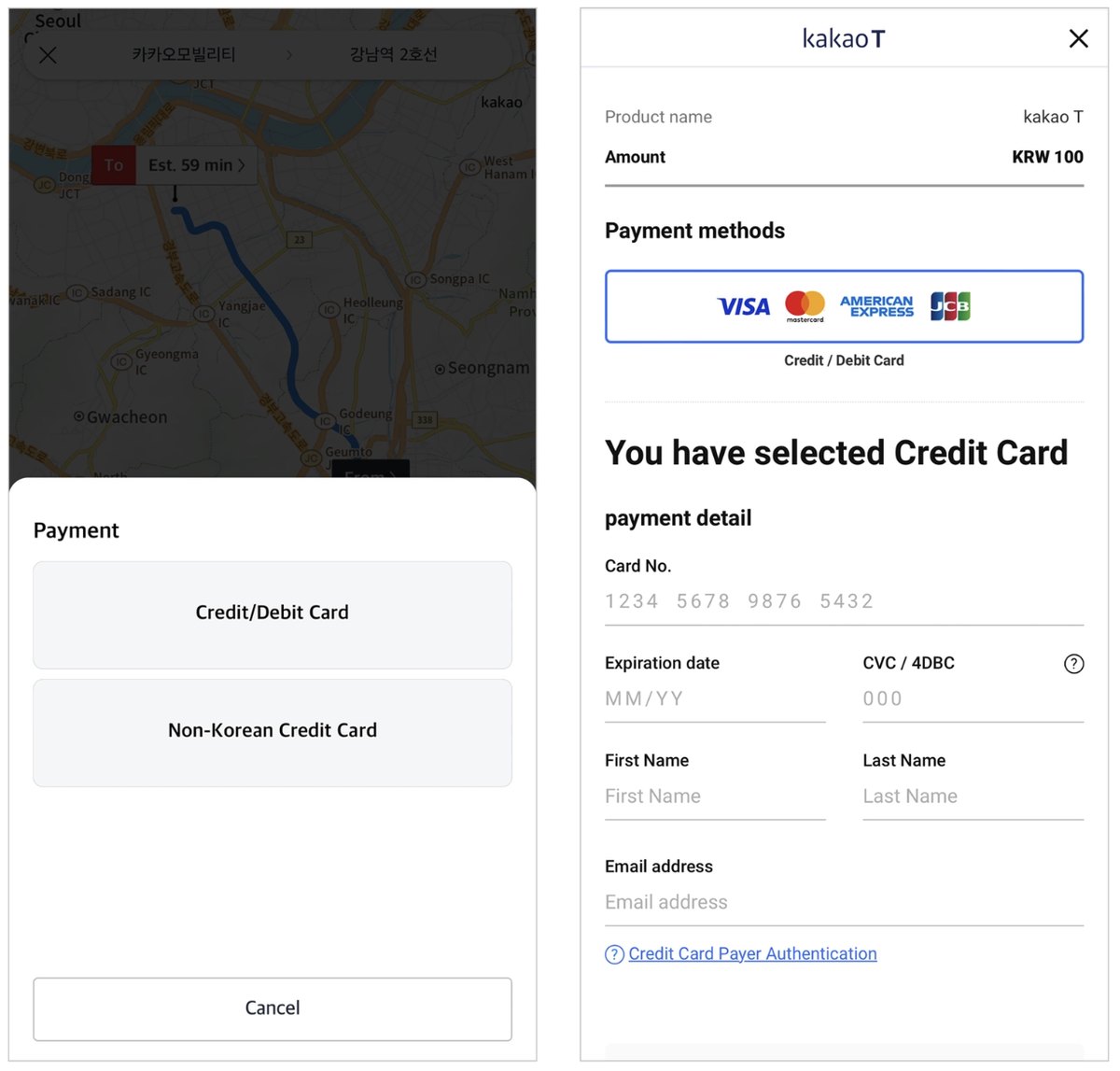
That 100 won (about 7 cents) is a verification charge, not a fee.
It doesn’t always take. Success depends on your issuer, and some foreign cards get declined by the Korean payment gateway for reasons nobody can explain to you. So:
Have a plan B before you need one. Either keep enough cash for a ride or two, or choose pay the driver when you book and settle at the end. Korean taxi card terminals also sometimes refuse foreign cards, which is why cash is the thing that always works.
Calling one, and the trap in the menu
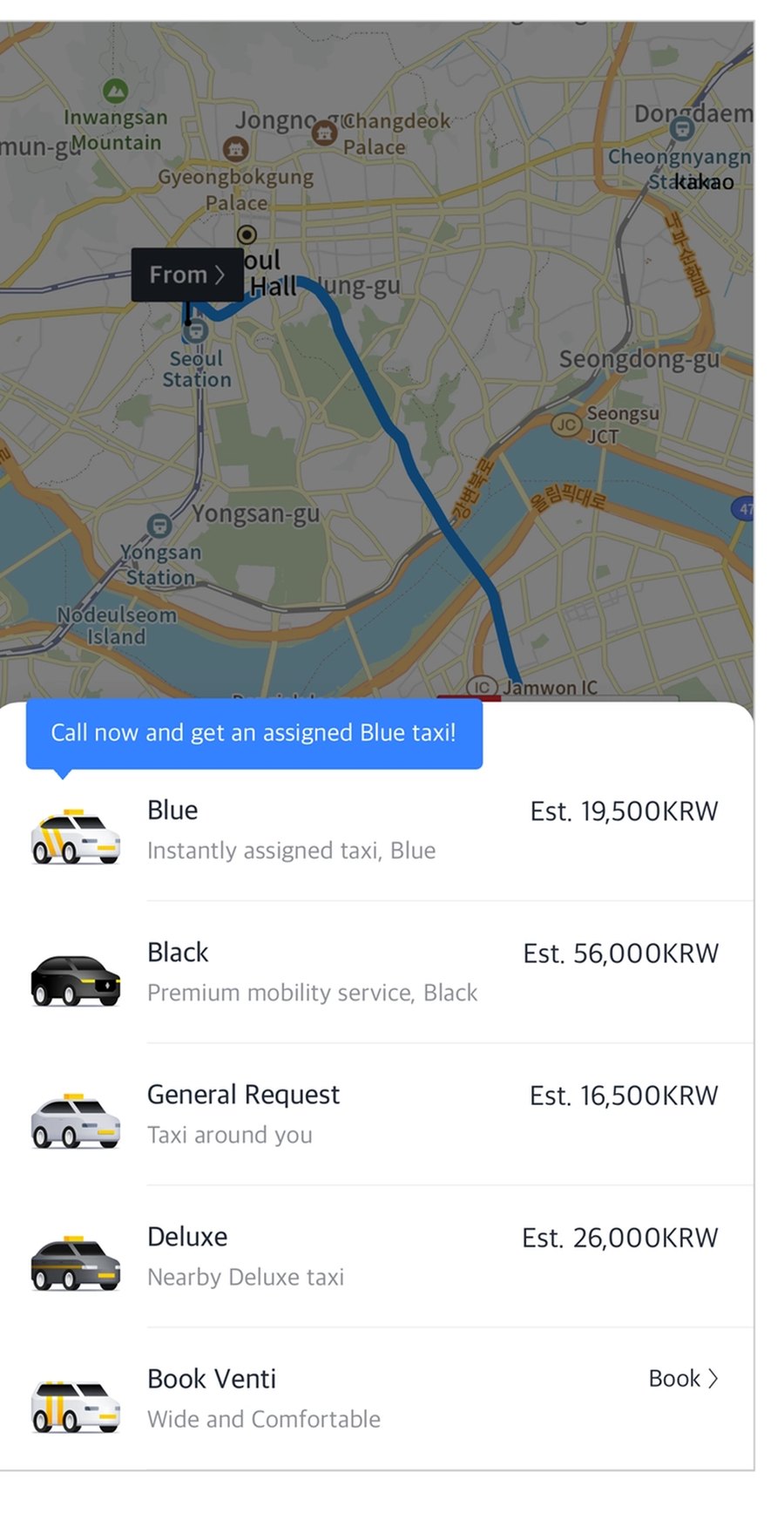
Type your destination in English. Landmarks, stations and hotels resolve fine. Smaller places may need the Korean name, which you can paste from a map app.
This is the part that quietly matters: the driver never has to understand your accent. He gets the address on his screen. (See above for what happens when he doesn’t.)
Now look at that fare column, because this is where visitors actually lose money. Same trip, same moment:
| Option | Estimate | What it is |
|---|---|---|
| General Request | 16,500 won | A normal metered taxi. This is the one you want. |
| Blue | 19,500 won | Normal taxi, guaranteed instant assignment |
| Deluxe (모범) | 26,000 won | Premium black-and-gold tariff — 1.6× |
| Black | 56,000 won | Premium chauffeur service — 3.4× |
Nobody is scamming you. The app is showing you a menu and the expensive options are one thumb-width away from the cheap one, in a list, in a language you just switched to, while you’re tired.
Default to General Request. Blue is worth the extra ~3,000 won if you’re somewhere quiet and want a car guaranteed now. Black is a chauffeur service and should be a deliberate choice.
You then get the car’s plate number and the estimate before it arrives. Check the plate against the car that pulls up. That’s the whole safety routine.
If you don’t install it
You do it the old way: stand at the edge of the road with your arm out and wait.
That’s not a joke, it’s just what the alternative is. You look for a taxi with a red 빈차 (bincha, “empty”) light lit in the windshield, you put your hand out, and you hope it stops. Then you say your destination out loud, in Korean, to a driver who may or may not catch it, with no fare estimate and no record of the trip.
It works. Locals do it all the time. But every single problem in the section below — the refusals, the wrong vehicle class, the destination getting misheard — comes from doing it this way.
Ten minutes of setup on hotel wifi removes all of it.
If you do end up talking to a driver
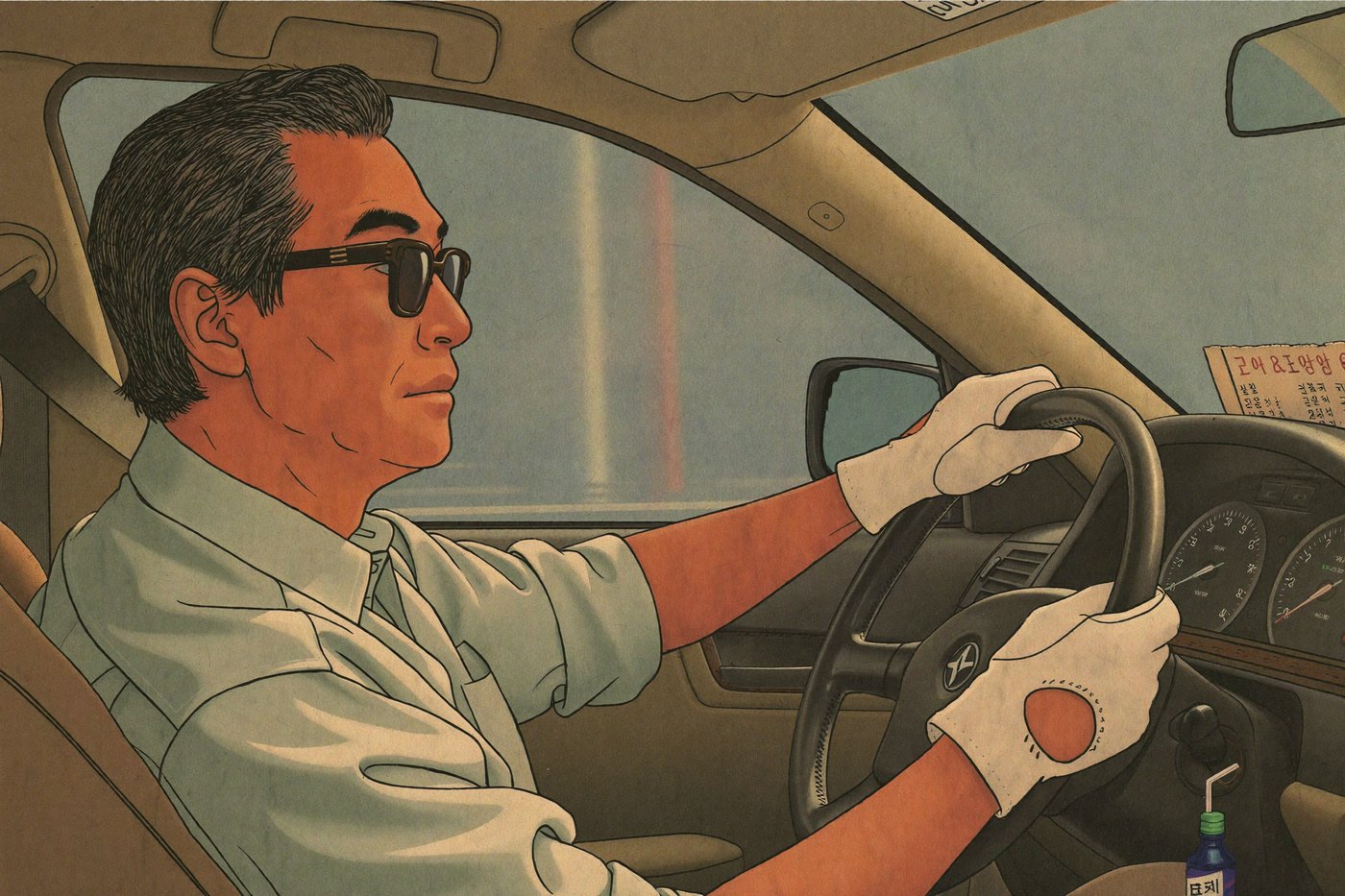
Worth knowing who you’re talking to: most Seoul taxi drivers are in their fifties and sixties. It’s not a young person’s job here. Which means English is genuinely hit-or-miss, and the ones who don’t have it are often a little embarrassed about it.
So don’t build a sentence. Say the place name and nothing else.
❌ “Excuse me, could you please take us to Gyeongbokgung Palace?” ✅ “경복궁.” (Gyeongbokgung.)
A full English sentence buries the one word that matters inside words he has to filter out. The bare place name — even pronounced badly — lands, because he’s heard it ten thousand times.
And don’t say the neighbourhood — say the building
This is the part that costs people twenty minutes of walking, and almost no guide mentions it.
If you say “Hongdae”, you will get dropped at the subway station exit. Same with Gangnam, same with Myeongdong. Those aren’t addresses, they’re districts — several square kilometres of them — so the driver takes you to the default landing point, which is the station, and everyone considers the job done.
If your actual destination was a cafe fifteen minutes’ walk the other side of the neighbourhood, that’s on you.
Say a specific place instead. In rough order of how reliably it lands:
| Say this | Why it works |
|---|---|
| Your hotel’s name | Drivers know hotels. This is the single best one |
| A famous building — 63빌딩, 롯데월드타워, 코엑스, DDP | Unmistakable, no address needed |
| A department store or big shop name | Same idea, and there’s usually only one |
| A street name — 가로수길, 이태원로 | Narrower than a district |
| You’re getting the station exit |
Broad names are fine if the station is genuinely where you’re going. Otherwise you’ve just paid for a ride to the wrong end of the area.
And the universal fallback: show him your phone. Have the destination pulled up in Korean on a map app before you get in. Nobody minds, and it ends the conversation instantly.
This is also the single best argument for Kakao T. You type it. Nobody has to understand anybody.
The things that actually go wrong
Genuine problems, in rough order of how likely you are to meet them:
1. Refusal to take you. The most common Seoul taxi complaint, and it’s about destination, not money — a driver near the end of a shift doesn’t want to cross the river. Street-hailing at 1am on a Friday in Hongdae is where this happens. Kakao T removes it, because the driver accepts before you get in.
2. Deluxe taxis you didn’t mean to take. 모범택시 are black with a gold sign on top, they are a legitimate premium service, and they cost noticeably more than the standard orange/silver ones. Nobody is tricking you. Look at the car before you get in.
3. Airport touts offering a “flat rate.” At Incheon arrivals, anyone approaching you offering a fixed price ride is not a metered taxi. The metered ranks are outside, clearly signed. A negotiated flat price is always worse than the meter.
4. The meter not being started. Rare, and mostly resolved by looking at it. If it isn’t running, say something before you’re moving.
What to do if the number looks wrong
Take the receipt. Every Seoul taxi must give one, and it has the vehicle number on it. With a Kakao T trip you already have the whole record in the app.
Seoul runs a complaints line (120, the Dasan call center) with English support. Realistically you won’t need it — but the existence of a paper trail is why the system mostly behaves.
Quick reference
| Tip the driver? | No |
| Base fare | 4,800 won / 1.6 km |
| Meter creeping while stopped? | Normal — 100 won per 30 sec |
| 20% surcharge to the airport? | Legitimate — you left Seoul |
| Offered a flat price at arrivals? | Walk away |
| Best default | Kakao T |
What I couldn’t verify
- Exact road distances for each route — I used approximate figures, so the table shows the shape of the fare, not a guaranteed quote. Your actual meter will differ with route and time of day.
- Deluxe (모범) taxi rates — they run on a separate, higher tariff and I haven’t confirmed the current numbers, so I’m not quoting them.
- Uber’s pricing relative to Kakao T on the same route — I haven’t run a side-by-side.
- How often the Non-Korean Credit Card registration actually succeeds — the option is there and I’ve seen the screen, but success reportedly varies by card issuer. I can’t give you odds, which is why the advice is to carry cash as a fallback rather than to rely on it.
Got a taxi receipt that looks off? Send me a photo and I’ll add it here.
Related guides
- Incheon Airport to Seoul for 5,000 won — the airport train, and the one case where a taxi from the airport is genuinely the right call.
- Food prices in Korea: three price tags — what a normal day of eating costs, photographed.
- Korean fried chicken: what it actually costs — the delivery order you’ll probably make on night one.
Common questions
Do you tip taxi drivers in Korea?
No. There is no tipping in Korea, in taxis or anywhere else. Pay the meter and go. Drivers do not expect a round-up and will often hand back change you try to leave.
How much is a taxi from Incheon Airport to central Seoul?
Roughly 59,000 won (about $43) on the meter in clear traffic, because the trip leaves Seoul city limits and picks up a 20% out-of-city surcharge. Between 11pm and 2am the late-night surcharge pushes it toward 79,000 won (about $57).
Is Kakao T safe for foreigners?
Yes, and it is the single best defence against being overcharged. The fare is estimated up front, the driver accepts before you board, and the route is logged. Sign-up works with an overseas phone number. Do not count on registering a foreign card for in-app payment — choose pay-the-driver instead and settle with cash or card at the end.
Is there Uber in Korea?
Not the way you know it. The private-driver model was legislated out, so ride-hailing here dispatches licensed taxis instead. Uber does operate in Korea, but it sends you a regular metered taxi — the same supply Kakao T uses. Kakao T is what locals actually have installed, and Koreans complain about the lack of alternatives as much as visitors do.
Do Seoul taxi drivers speak English?
Often not much. Most drivers are in their fifties and sixties and English is hit-or-miss. Say only the place name rather than a full English sentence — and make it a specific one. A neighbourhood name like Hongdae or Gangnam will get you dropped at the subway station, because that is the default landing point for a whole district. Name your hotel, a famous building, or a street instead. Or just show the destination on your phone. Kakao T avoids the problem entirely because you type the address.
What is the Seoul taxi base fare in 2026?
4,800 won for the first 1.6km for a standard medium taxi, then 100 won per 131 metres, plus 100 won per 30 seconds when the car is crawling or stopped.